
Field Notes — Part 3 — “Bang”
For the ones who stayed. And the ones who couldn’t.

There is a question I have been asking for thirty years.
I will never have the answer. I have dedicated my life to making sure other people don’t have to live inside that question the way I have. But the question itself never leaves. It just gets quieter some years and louder in others.
Why.
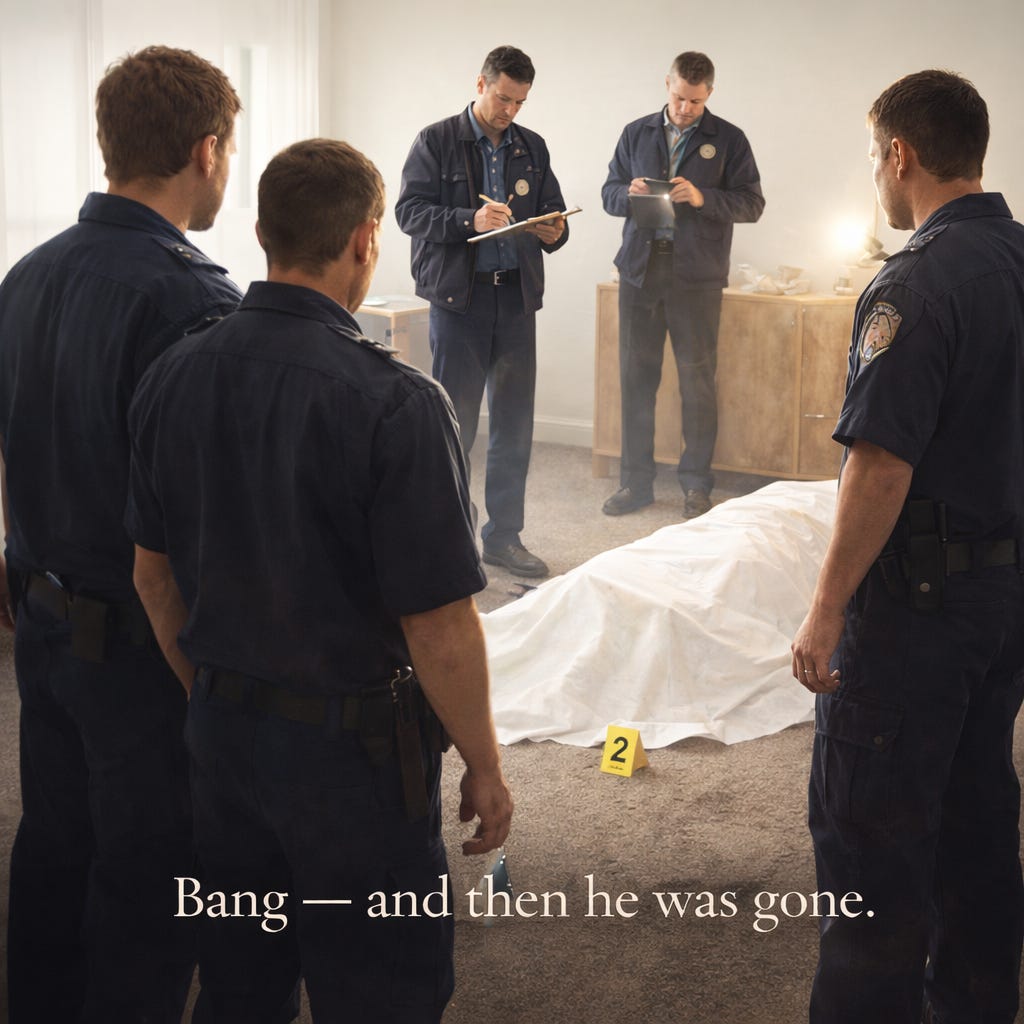
He was a paramedic. One of us in the purest sense of that word — not just by credential but by nature. The kind of person the job fits like a second skin. His brother was a cop. He had gone through law school at the top of his class, which told you something about his mind, and then somewhere between that version of himself and the version sitting in that house with four roommates who were all paramedics, something had come loose.
We didn’t see it. Or we saw it and called it something else.
That’s the thing about protecting one of our own. We are extraordinarily good at it. We close ranks instinctively — it’s the same impulse that makes us good at the job. You don’t leave a partner behind. You don’t expose a weakness in the line. You make excuses that sound like loyalty and you tell yourself you’re helping and you keep showing up for shift and you don’t ask the question directly because asking it directly would mean admitting that something is really wrong.
His wife asked the question directly. His kids felt the answer in ways children shouldn’t have to feel anything. They left because they had to. Because the thing we were all protecting him from was also the thing that was consuming his marriage and his fatherhood and whatever was left of the man who had walked out of law school at the top of his class.
We kept making excuses long after his family ran out of them.
It happened in the middle of the night.
His roommates were there. His friends. His partners. The people who knew him better than almost anyone — who had been on scene with him, who had eaten with him, who had shared the particular intimacy of shift work that civilians don’t have language for.
He reached into a side pocket in the chair where he kept the gun.
And then he was gone. Just like that. The way the job takes people sometimes — not slowly, not with warning, but with a terrible sudden finality that leaves everyone in the room trying to understand what just happened.
Bang.
Some people ran. I understand that. I don’t say it with judgment because I have never been in that room and I don’t know what I would have done and neither do you until you’re there. Trauma makes people move in directions they never anticipated. Flight is as human as anything else.
His best friend stayed.
I want you to sit with that for a moment. The particular weight of being the one who stays. Who doesn’t run. Who looks at what’s in front of them and decides that this person deserves someone to remain. That is its own kind of heroism that nobody gives a medal for and nobody puts in the report.
Someone got the drugs off scene before the police arrived. I understand that too. The calculus of protection running automatically even in the worst moment — he’s gone, but we can still protect him from what comes next. We are wired for it. It doesn’t make it right. It makes it human.
Then the investigation came.
The investigation is what nobody warns you about.
You have just watched someone you love die in the most violent and irreversible way imaginable and now there are people asking you questions with clipboards and you are expected to be coherent and accurate and cooperative and you feel like absolute hell and there is nothing — no protocol, no training, no debrief — that adequately prepares you for what it feels like to be investigated in the aftermath of a suicide you didn’t prevent.
We all felt like we had failed him.
We had failed him. That’s the truth I’ve had to sit with. Not in the way the investigation implied — none of us pulled that trigger. But we had participated in a culture that made it easier for him to hide than to ask for help. We had loved him in the way first responders love each other, which is fierce and loyal and sometimes completely blind.
He did it to himself.
He also did it to us. I say that not with anger — not anymore — but with the clinical honesty of someone who has sat with enough survivors of suicide loss to know that this truth needs naming. When someone takes their life in front of the people who love them, they leave something behind that doesn’t have a clean name. Not just grief. Something more complicated. Grief and guilt and anger and love all tangled together in a way that the stages of grief models don’t account for.
Most of us didn’t recover. Not really. Not all the way.
Some of us did.
I’m still not entirely sure which category I fall into on any given day.
He was one of a hundred and fifty.
But he was the one who made me need to understand why.
Not just his why — though I have turned that question over in my mind for three decades. The larger why. Why does this job do this to people. Why does the culture that saves lives also cost them. Why do we protect each other so fiercely from the very help that might keep us alive. Why does a man who walked out of law school at the top of his class end up in a house with four paramedic roommates reaching into a chair at three in the morning.
That why is the reason I spent a few years in Jungian psychoanalysis. The reason I became a therapist. The reason I built an institute. The reason you are reading this right now.
He is the reason.
Not the only reason. But the one that sits closest to the beginning.
I want to tell you something about the ones who stayed in that room.
They carried what happened on their bodies for years. Some of them are still carrying it. The image doesn’t leave — that’s not how trauma works, regardless of what we tell ourselves about being tough enough to handle it. The nervous system doesn’t grade on a curve. It doesn’t care that you’ve seen worse on the job. It stores what it stores and it surfaces when it surfaces and the only way through it is the way nobody in first responder culture wants to talk about.
You have to feel it.
Not perform it. Not debrief it in a conference room forty-eight hours later with a peer support person reading from a script. Actually feel it — in the body, in the dark, with someone who knows how to sit with you in that kind of pain without flinching.
That’s what he deserved when he was still alive.
That’s what his roommates deserved after.
That’s what we all deserve and almost none of us ever get.
The question why is one I will never fully answer for him specifically.
But I have spent thirty years answering it for everyone else.
Every first responder who sits across from me in a therapy room. Every clinician I’ve trained. Every essay I’ve written. Every Sunday morning I show up here and put words to the things this culture teaches us to leave unsaid.
That’s what you do with a why you can’t resolve.
You dedicate your life to making sure fewer people have to ask it.
He taught me that.
Bang — and then he was gone.
And I have been answering for him ever since.
Next in Field Notes from the Fire: “The First Time I Told the Truth” — on the moment the armor cracked, and what it cost to let it
The Wounded Healer is free to read. The Wounded Healer Inner Circle is where you belong.
If these essays have found you at the right moment — if you’re ready to move beyond the page into live roundtables, deeper clinical reflections, and a community of first responders and clinicians doing this work with full seriousness — this is where that happens.
You’re not paying for content. You’re funding the path back for every first responder still in the fog. The tribe is waiting.
Joseph Brigandi, The Wounded Healer on Substack © 2026
IF YOU’VE BEEN READING QUIETLY
This is your personal invitation from Joseph Brigandi. Not to just read more essays but to belong to The Wounded Healer Community and to help it grow.
Join us here: 👉 https://frbhi.com/the-wounded-healer-community-subscription/