

You’re in the kitchen at the station.
Someone ate your leftovers from the fridge. Again.
And suddenly you’re not just annoyed—you’re **enraged**. Not frustrated. Not irritated. Enraged. You want to put someone through a wall over a goddamn sandwich.
You catch yourself mid-fury and think: *What the hell is wrong with me?*
But here’s the thing: nothing is wrong with you.
Something is **hunting** you.
---
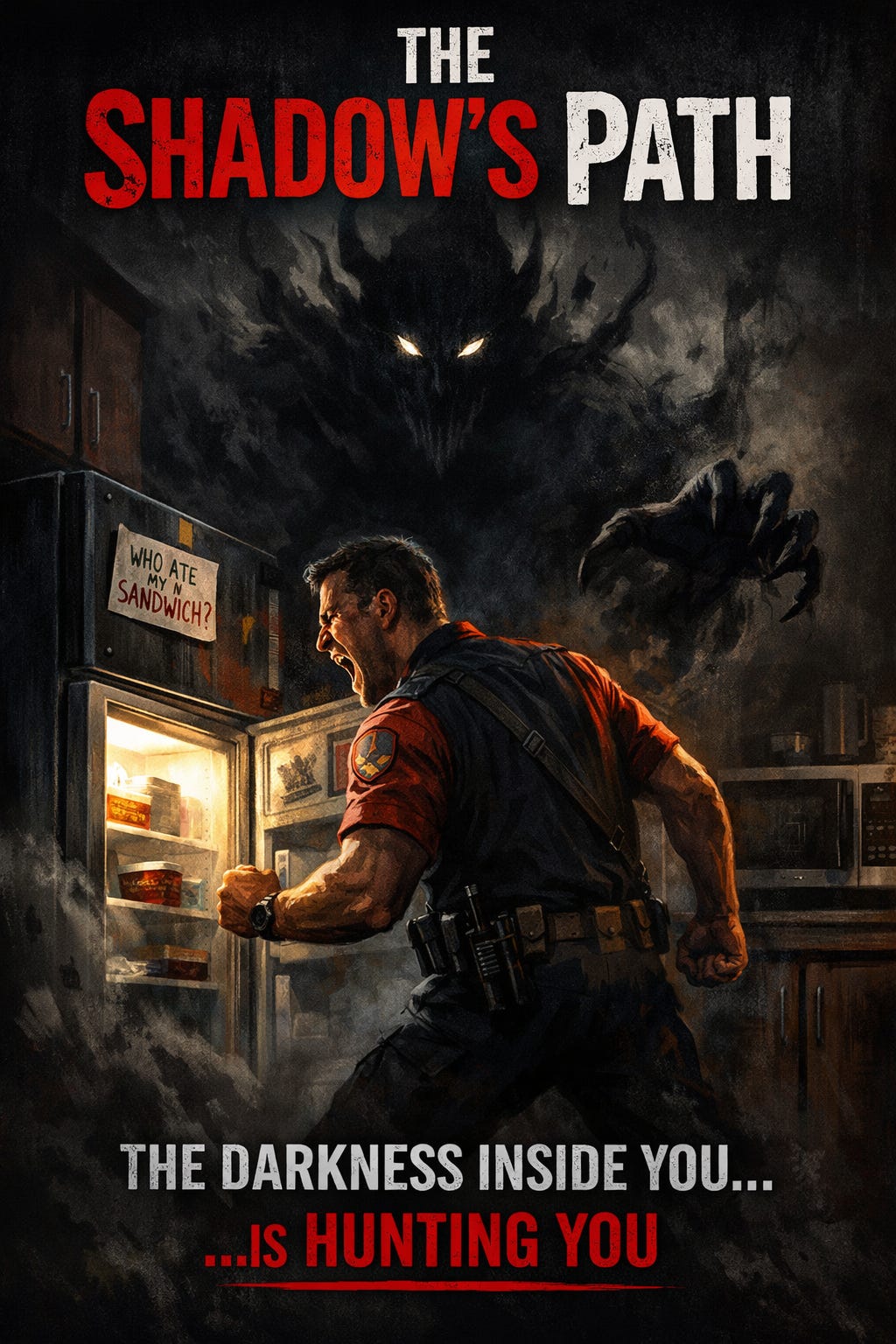
Carl Jung called it **the shadow.**
Not the darkness you see. The darkness you **are**—and refuse to admit.
Everything you’ve disowned, denied, buried, and exiled about yourself doesn’t disappear. It goes underground. It gathers strength. And when you’re not looking, it possesses you.
That explosion over the sandwich? That wasn’t about food.
That was your shadow speaking.
And for first responders, the shadow doesn’t just whisper. It **screams**.
---
## What Jung Meant By “The Shadow”
Here’s Jung in plain language:
**The shadow is the part of yourself you refuse to acknowledge.**
Everything you’ve decided is unacceptable about yourself—the rage, the fear, the shame, the weakness, the perversion, the cruelty, the neediness—doesn’t vanish just because you won’t claim it.
It goes into the **unconscious.**
The shadow is your **personal unconscious**—the storehouse of everything you’ve repressed because it didn’t fit who you needed to be.
For most people, the shadow is manageable. A little jealousy here. Some passive aggression there. Irritability they don’t understand.
For first responders? The shadow is **volcanic.**
---
## Why First Responders Carry a Double Shadow
You don’t just have one shadow. You have **two.**
**Shadow #1: What You Brought With You**
Before you ever put on a uniform, you already had shadow material.
The childhood you survived. The father who left. The mother who drank. The abuse you don’t talk about. The poverty that taught you the world isn’t safe. The sibling who got the love you didn’t.
You became a first responder, in part, because of wounds you couldn’t name.
We’ll explore this more in Part 2, but for now, know this: **you didn’t choose this job randomly. Your shadow chose it for you.**
You needed to save others because you couldn’t save yourself. You needed to feel powerful because you felt helpless. You needed to matter because you were told you didn’t.
That’s **Shadow #1**—the one you brought to the academy.
---
**Shadow #2: What the Job Created**
Then you started working.
And you saw things no human being should see.
Dead kids. Burned bodies. People begging you to save them when you couldn’t. Violence. Suffering. The randomness of who lives and who dies.
You absorbed all of it.
But you couldn’t process it. You couldn’t talk about it. You couldn’t even **feel** it most of the time, because if you did, you wouldn’t be able to go back on shift.
So you buried it.
The grief. The horror. The helplessness. The rage at the universe for being so goddamn cruel. The guilt for the ones you couldn’t save. The shame for the times you failed.
All of that went into the shadow.
**And it’s still there.**
---
## The Shadow Doesn’t Stay Buried
Here’s what Jung understood that most therapists miss:
**What you repress doesn’t disappear. It gains autonomy.**
The shadow becomes its own force inside you. It has its own agenda. And when you’re not paying attention—when you’re tired, when you’re stressed, when your defenses are down—**it takes over.**
That’s why you exploded over the sandwich.
That’s why you can’t stand certain people for reasons you can’t articulate.
That’s why you rage at your spouse over trivial shit.
That’s why you feel nothing during calls but lose your mind in traffic.
That’s why you drink too much, work too much, isolate too much, numb too much.
**You’re not crazy. You’re possessed.**
The shadow you won’t face is running the show.
---
## The Shadows First Responders Deny
Let me name some of the shadow material first responders carry—and refuse to acknowledge:
**The Rage Shadow**
You’re supposed to be calm, professional, controlled. So the rage at the drunk driver who killed a family, the rage at the abusive parent, the rage at the system that failed the patient, the rage at your department for betraying you—all of that gets buried.
But it’s still there. And it comes out sideways. At your kids. Your spouse. The guy who cut you off in traffic.
**The Grief Shadow**
You’re supposed to be tough. So you don’t cry at the dead kid call. You don’t break down when your partner dies. You don’t grieve the 150+ colleagues you’ve lost.
But the grief is still there. Frozen in your body. Waiting.
**The Helplessness Shadow**
You became a first responder to help people. But sometimes you can’t. And that helplessness—the patient who died despite your best efforts, the person you couldn’t reach in time, the colleague you couldn’t save from suicide—**that** is unbearable.
So you bury it. You tell yourself you did everything you could. You move on to the next call.
But the helplessness shadow remains. And it whispers: *You weren’t enough.*
**The Shame Shadow**
The times you froze. The mistakes you made. The call you fucked up. The person who died because you were two minutes too slow. The moral injury of following orders you knew were wrong.
The shame is there. You just won’t look at it.
**The Fear Shadow**
You’re supposed to be brave. So you can’t admit you’re terrified. Not just on dangerous calls—you’re trained for that. You’re terrified of being weak. Of needing help. Of not being enough. Of losing control.
That fear goes into the shadow. And from there, it runs your life.
**The Childhood Shadow**
And underneath all the job-created shadow material is the original wound. The one you brought with you.
The father who said you’d never amount to anything.
The mother who couldn’t protect you.
The abuse no one believed.
The poverty that taught you survival, not safety.
The sibling who died.
The family that fell apart.
You became a first responder, in part, to prove something. To save someone. To matter.
But the wound is still there. Unhealed. Driving everything.
---
## The Moment of Recognition
Most first responders never see their shadow.
They live possessed by it—enraged, numb, isolated, self-destructive—and they think that’s just who they are.
But there’s a moment—if you’re lucky, if you’re paying attention—when the shadow **reveals itself.**
It’s the moment you realize:
*That explosion wasn’t about the sandwich.*
*That rage wasn’t about this call.*
*That numbness isn’t strength—it’s defense.*
*That isolation isn’t independence—it’s terror.*
**The shadow is everything you’ve refused to see about yourself.**
And it’s been running your life.
---
## What Happens If You Keep Denying It
Jung was clear about this:
**”Until you make the unconscious conscious, it will direct your life and you will call it fate.”**
If you don’t face your shadow, it will destroy you.
Not dramatically. Not all at once. Slowly.
You’ll push away everyone who loves you.
You’ll numb yourself until you can’t feel anything.
You’ll rage at people who don’t deserve it.
You’ll self-sabotage every good thing in your life.
You’ll drink, work, isolate, or disappear.
And one day, if you’re one of the unlucky ones, **the shadow will convince you that ending your life is the only way out.**
I’ve lost 150+ colleagues to suicide.
Not one of them died because they were weak.
They died because they couldn’t face what they were carrying in the dark.
**Their shadow devoured them.**
---
## The Way Forward
Here’s what I learned in six years of Jungian analysis:
**You can’t kill the shadow. You have to integrate it.**
You have to turn and face what you’ve been running from.
The rage. The grief. The helplessness. The shame. The fear. The childhood wound that started it all.
Not to make it go away. But to make it **conscious.**
Because once you see it—once you acknowledge it, name it, sit with it—it loses its power over you.
The shadow only possesses you when you refuse to look at it.
The moment you turn toward it, the moment you say *”Yes, that rage is mine. That grief is mine. That fear is mine.”*—
**That’s when integration begins.**
That’s when you stop being haunted by your own darkness.
That’s when you become whole.
---
## What’s Coming
Over the next 11 parts of this series, we’re going into the shadow.
Not theoretically. Viscerally.
We’re going to explore:
- The childhood shadow that chose your career (Part 2)
- Why you hate the people you hate—projection (Part 3)
- The positive qualities you buried to survive (Part 4)
- The toxic culture you’ve absorbed (Part 5)
- Dissociation as shadow exile (Part 6)
- How to actually integrate the shadow (Part 7)
- Moral injury and shame (Part 8)
- The masculine/feminine shadow (Part 9)
- Shadow and suicide (Part 10)
- What integration gives you (Part 11)
- Living with your shadow integrated (Part 12)
This isn’t therapy.
This is **alchemy.**
Turning the darkness you fear into the wisdom you need.
---
## One Last Thing
If you’re reading this and something stirred—
If you recognized yourself in the rage over the sandwich, the numbness you can’t explain, the isolation you can’t break—
**That’s your shadow speaking.**
And here’s what it’s trying to tell you:
*I’m still here. I’ve been waiting. And I’m not going away until you face me.*
The good news?
You don’t have to do this alone.
I’ve walked this path. I’ll walk it with you.
**Welcome to The Shadow’s Path.**
---
**Next in the series:**
**Part 2: The Childhood Shadow That Chose the Badge**
*Why you became a first responder—and what that reveals about your wound.*
---
**Subscribe to The Wounded Healer** to receive each part of this series.
**Reply to this post** and tell me: When did you first realize something was hunting you?
---
**Joseph Brigandi, LPC-S**
*35 years as a paramedic and Fire Captain. Six years in Jungian analysis. Now teaching the path I walked.*
---
*”Everyone carries a shadow, and the less it is embodied in the individual’s conscious life, the blacker and denser it is.”* — Carl Jung
The Wounded Healer is free to read. The Wounded Healer Inner Circle is where you belong.
If these essays have found you at the right moment — if you’re ready to move beyond the page into live roundtables, deeper clinical reflections, and a community of first responders and clinicians doing this work with full seriousness — this is where that happens.
You’re not paying for content. You’re funding the path back for every first responder still in the fog. The tribe is waiting.
Joseph Brigandi, The Wounded Healer on Substack © 2026
IF YOU’VE BEEN READING QUIETLY
This is your personal invitation from Joseph Brigandi. Not to just read more essays but to belong to The Wounded Healer Community and to help it grow.
Join us here: 👉 https://frbhi.com/the-wounded-healer-community-subscription/